
PCB Assembly Service
Precision PCB Assembly for Regulated & High-Reliability Industries.
From prototype to full production – built to exceed MedTech, CleanTech, Defence & standards. ISO 13485, 9001 & 14001 Certified.

Built for High-Stakes Industries
- Medical Devices (ISO 13485)
- CleanTech
- Aerospace & Defence
Reliability. IPC Class 2 Standard
We don’t just assemble PCBs; we validate! With 100% Automated Optical Inspection (AOI) and IPC-A-610 trained staff, we ensure ‘Detail, Reliability & Traceability in every PCB Assembly Board
Scalability. NPI to Volume
Bridge the gap between concept and commercial reality. Our New Product Introduction (NPI) process ensures your prototype is ready for mass manufacture
Traceability. Full Traceability
Comprehensive PCB Assembly Capabilities
Surface-Mount Technology (SMT) is the dominant and most efficient process for modern PCB design and assembly.Unlike traditional through-hole mounting, SMT involves directly securing electronic components onto the surface of the Printed Circuit Board (PCB) using solder paste, eliminating the need for drilled holes.
Advantages of Choosing SMT Assembly
Choosing SMT for your project offers several key benefits:
• Increased Component Density: Surface-mount components are inherently smaller. This allows more components to be fitted onto complex, miniaturized PCBs, making high-density designs possible.
• Faster and Cheaper Production: The SMT process is highly automated, leading to significantly faster assembly times and reduced manufacturing costs.
• Cost Savings for Customers: The combined efficiency and material advantages translate directly into competitive pricing and cost savings for our customers.
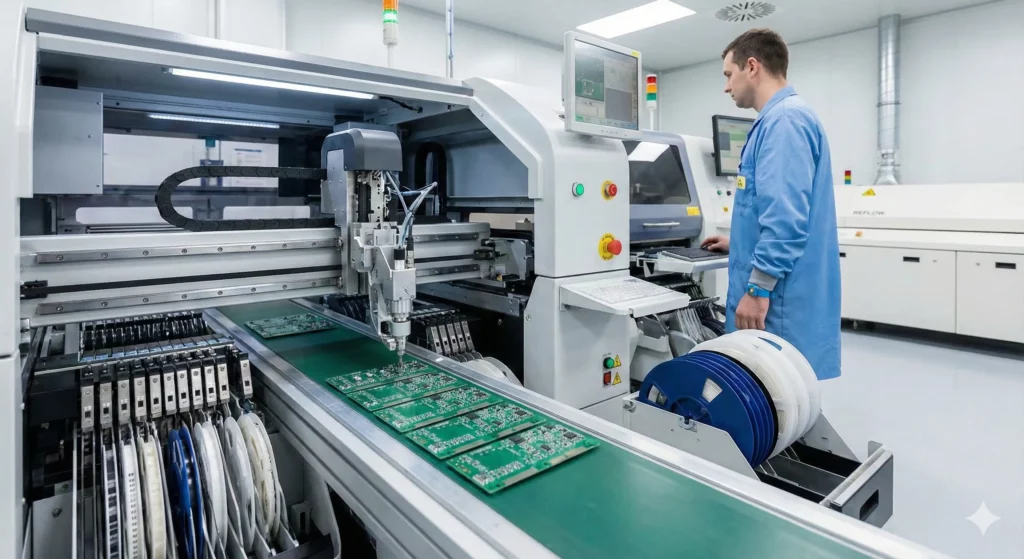
Surface Mount Technology for PCB Assembly
At Cogent Technology, we specialise in Through-Hole PCB Assembly for critical applications where strength, longevity, and durability are non-negotiable. While Surface Mount Technology (SMT) is the standard for miniaturisation, it cannot always match the physical robustness required for high-stress environments.
Why Choose Through-Hole Technology?
Certain components and operating environments demand superior mechanical integrity. Through-hole soldering provides a bond that SMT simply cannot replicate, making it the essential choice for:
• Heavy Components: Secure mounting for large transformers, heavy connectors, and relays.
• High-Stress Environments: Applications subject to extreme vibration, mechanical stress, or high power loads.
• Odd-Form Parts: Specialized components that require manual or semi-automated insertion.
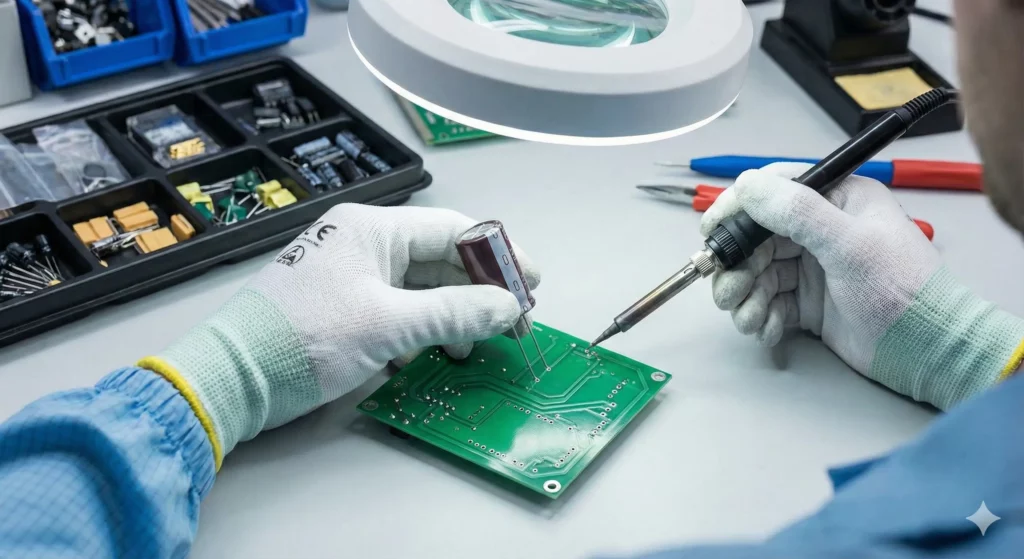
Our facility combines the best of both worlds. Whether your design requires a fully through-hole board or a hybrid SMT/through-hole assembly, our skilled technicians ensure precision and repeatability.
From initial prototyping to full-scale production, Cogent Technology delivers PCBs built to withstand the toughest conditions, ensuring your product performs reliably for the long haul.
Cogent Technology offers a comprehensive range of PCB and electronic functional testing services. From simple power checks, programming, XJTAG and AOI through to calibration and product conformance all performed by skilled engineers in accordance with PCB Test and Inspection procedure
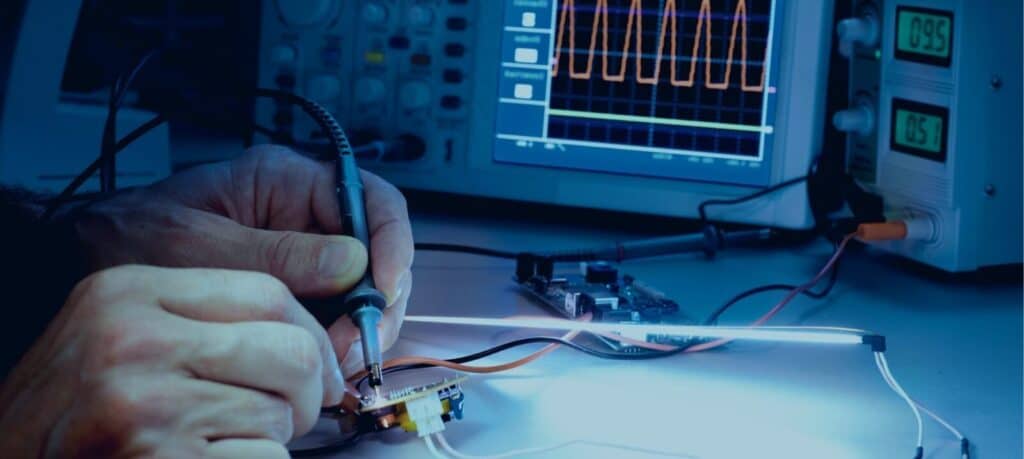
Cogent Technology has been manufacturing complete instrumentation systems since its formation in 1985 and has extensive experience in supplying full device build, assembled, tested and commissioned to your specification and to the standards defined by IPC630 and the J-Std. Every step of the assembly, the origin of every component with who did what, when and where is recorded to meet the traceability requirements of ISO13485 for medical device build underpinned by a complete Device History Record (DHR).

Specialist Medical Electronics Manufacturing
In the medical sector, precision is a matter of life. As a trusted ISO 13485 PCB manufacturer, Cogent Technology delivers the rigorous quality management required for Class II and Class III medical devices.
We supported the UK Government’s Ventilator Challenge, proving our ability to deliver critical technology under pressure. From NPI to full-scale production, we ensure your life-critical devices are built with genuine care.”
From Design to Delivery
1. Design Review
2. Component Sourcing
3. PCB Assembly
4. Testing & Inspection
5. Delivery
The innovation, collaboration and resolve you showed in taking up the gauntlet of the Ventilator Challenge has been inspirational.. your achievements are remarkable. Once again, I would like to pass on the Government’s gratitude to you and your whole team.
Rt Hon Michael Gove MP
Ready to Enhance Lives?
Partner with the UK's most dedicated
PCB assembly service
How does PCB assembly work?
PCB Assembly (PCBA) is the process of transforming a bare "blank" circuit board into a fully functional electronic device by accurately attaching and soldering components. At Cogent Technology, this process is governed by our MaPS system, ensuring full traceability and world-class quality at every stage.
The process generally follows these five core phases:
1. Front-End Engineering & DFM Review
Before any physical assembly begins, our engineers perform a Design for Manufacture (DFM) review. We analyse your Gerber files and Bill of Materials (BOM) to identify potential production issues early, ensuring the design is optimised for high-yield manufacturing.
2. Solder Paste Application (SMT)
For Surface Mount Technology (SMT), we use a precision laser-cut stencil to apply a specialised solder paste a mix of tiny solder balls and flux exactly onto the pads where components will sit.
3. Automated Component Placement
Our high-speed automated "pick-and-place" machines then take over. Using your design's X/Y coordinates, these machines place components with incredible precision (down to ±0.05 mm) onto the solder-pasted pads.
4. Reflow and Through-Hole Soldering
The boards then move through a Reflow Oven, which uses controlled temperature zones to melt the solder paste, creating permanent, reliable electrical joints.
For Through-Hole components: If your design includes larger parts that go through the board, we use Wave Soldering or Selective Soldering to secure them.
5. Rigorous Inspection & Testing
Quality is non-negotiable. We utilise a multi-layered inspection strategy to ensure every board meets IPC-A-610 standards:
AOI (Automated Optical Inspection): High-powered cameras scan for placement accuracy and solder defects.
X-Ray Inspection: Used for complex components like BGAs where solder joints are hidden from view.
Functional Testing: We power up the board to ensure it operates exactly to your specifications.
How much does PCB assembly cost?
Because every electronic design is unique, there is no "one-size-fits-all" price for PCB assembly. At Cogent Technology, we operate an Open Book policy, providing you with a clear breakdown of costs so you know exactly where your investment is going.
The total cost is determined by four primary "complexity drivers":
1. Component Count and Type
The number of individual parts (the Bill of Materials or BOM) is the largest factor.
SMT vs. Through-Hole: Automated Surface Mount (SMT) is generally more cost-effective for high volumes. Through-hole components often require manual labor or selective soldering, which can increase the unit price.
Component Complexity: Parts like BGAs (Ball Grid Arrays) require specialized X-ray inspection, while extremely small "01005" components require higher-precision placement.
2. Batch Size and Volume
PCB assembly carries Non-Recurring Expenditure (NRE) costs, such as machine programming and solder stencil fabrication.
Prototypes: For small runs (1–10 units), these setup costs are spread over fewer boards, resulting in a higher price per unit.
Series Production: For larger volumes, these fixed costs are amortized, and "economies of scale" significantly reduce the cost per board.
3. Board Complexity
The physical design of the bare PCB also impacts the price:
Layer Count: A 10-layer board is more expensive to fabricate and inspect than a 2-layer board.
Double-sided Assembly: If components are placed on both sides, the board must pass through the SMT line twice.
4. Testing and Compliance Requirements
The level of "peace of mind" required for your product affects the final cost. Basic visual inspection is standard, but high-reliability industries (like Medical or Aerospace) often require:
Functional Testing (FCT)
In-Circuit Testing (ICT)
Conformal Coating for harsh environments.
Cogent’s Tip: Engaging our engineers during the design phase for a DFM (Design for Manufacture) review can often identify ways to simplify your build and reduce overall costs before production begins.
What is our PCB assembly process?
.
How long does PCB assembly take
The lead time for a project is not a single fixed number; it is a timeline built from several moving parts. At Cogent Technology, we use our proprietary MaPS system to track every stage of your build in real-time, providing you with an accurate delivery date based on your specific requirements.
Generally, timelines are influenced by which "path" your project takes:
1. The Service Level
Fast Track / Prototyping: For urgent R&D requirements, we can often facilitate rapid turnarounds in as little as 3–5 working days (once all components and bare boards are at our facility).
NPI (New Product Introduction): This process is more thorough, involving DFM feedback and process proving. This typically takes 1–3 weeks as we ensure the product is "production-ready."
Series Production: Once a product is established, we often move to scheduled deliveries or Kanban arrangements, where we hold stock to meet your demand instantly.
2. The Supply Chain Factor
The biggest variable in any PCB assembly timeline is component procurement.
In-stock parts: Can be sourced in 24–48 hours.
Long-lead items: Some specialised silicon or custom magnetics can have lead times of several months.
Note: Cogent’s procurement team works proactively to identify these "long-lead" items during the quoting stage so we can secure them before they delay your build.
3. Build Complexity
The physical assembly time is dictated by the complexity of the board:
Single-sided SMT: The fastest to assemble.
Double-sided / Mixed Tech: Requires multiple passes through the SMT line and additional time for manual or selective soldering of through-hole parts.
Advanced Testing: Complex functional tests or "soak testing" (where the board is powered up for an extended period) will add time to the final dispatch.
Why you should talk to your Account Manager
Because we prioritize "On-Time Delivery" (OTD), we don't guess. Your Cogent Account Manager will look at our live capacity through the MaPS system and coordinate with our procurement team to give you a definitive schedule.
By having an early conversation, we can often "dovetail" our planning with yours—securing materials while you are still finalizing the design to compress the overall time-to-market.
What is SMT PCB assembly
SMT stands for Surface Mount Technology. It is the most common method used in modern electronics manufacturing to mount components (known as Surface Mount Devices or SMDs) directly onto the surface of a Printed Circuit Board.
Unlike the traditional "Through-Hole" method—where component legs are pushed through drilled holes and soldered on the underside—SMT components sit on top of copper pads on the board's surface.
The 3-Step SMT Process
At Cogent Technology, our SMT lines are highly automated to ensure repeatability and speed:
Solder Paste Printing: We use a precision stencil to apply a specialized solder paste onto the PCB's pads.
Pick and Place: Automated machines use vacuum nozzles to "pick" components from reels and "place" them onto the wet solder paste with micron-level accuracy.
Reflow Soldering: The populated board passes through a multi-zone oven. The heat melts the solder paste, creating a permanent electrical and mechanical bond as it cools.
Why use SMT instead of Through-Hole?
Miniaturisation: SMT components can be up to 10x smaller than through-hole parts, allowing for much smaller and lighter products.
Higher Density: Because components are smaller and don’t require holes through the board, we can pack many more features into a smaller footprint.
Double-Sided Assembly: SMT allows components to be placed on both sides of the board, effectively doubling the available design space.
Cost-Effectiveness at Scale: Because the process is almost entirely automated, it significantly reduces manual labor costs and human error for medium-to-high volume production.
When is SMT not used?
While SMT is the industry standard, some components—like heavy transformers, large connectors, or power-heavy switches—still require Through-Hole Technology (THT). These parts need the extra mechanical strength provided by pins passing through the board to withstand physical stress or high heat. At Cogent, we often use a "Mixed Technology" approach to give you the best of both worlds.
What is turnkey PCB assembly
Turnkey PCB assembly is essentially the "one-stop shop" model of electronics manufacturing. For a client, it means you provide the design files, and Cogent Technology takes care of everything else until a finished, tested board is delivered to your door.
Here is a draft for your FAQ:
What is turnkey PCB assembly?
The term "turnkey" comes from the idea that you only need to "turn the key" to start the engine. In the context of electronics, it means Cogent Technology manages the entire end-to-end production process on your behalf.
Instead of you having to coordinate between a bare-board manufacturer, multiple component distributors, and an assembly house, we consolidate the entire supply chain into a single, seamless workflow.
What is included in a Turnkey service?
When you choose a full turnkey solution with Cogent, we handle:
BOM Sourcing: Our procurement team buys every resistor, capacitor, and IC on your Bill of Materials from authorized, vetted suppliers.
PCB Fabrication: We coordinate the manufacturing of the bare circuit boards.
Assembly: We populate the boards using our high-speed SMT and Through-Hole lines.
Testing & Quality: We perform all necessary inspections (AOI, X-ray) and functional testing to ensure the boards work out of the box.
Box Build (Optional): We can even go beyond the board, installing the PCB into its final housing, adding cables, and providing retail-ready packaging.